
Blog Topics
Vermont’s forests and landscapes are changing. Warmer winters, shifting weather patterns, and longer growing seasons are allowing more invasive insects, fungal diseases, and environmental stressors to survive and spread farther north than they once could. Some tree pests and diseases, like emerald ash borer and hemlock woolly adelgid, are already established across much of the state, while newer threats, like beech leaf disease, are continuing to expand into additional counties each year.
For homeowners in South Burlington, Essex, Williston, and the rest of Chittenden County, spring has become an important window for identifying problems early—before stressed trees decline beyond the point where treatment is practical.
Key Takeaways
- Emerald ash borer is currently the most urgent tree pest threat in Vermont, with infestations now confirmed across nearly the entire state.
- Many tree pests and diseases are treatable if caught early, which makes routine inspections and early identification especially important.
- Common Vermont tree problems like beech leaf disease, spongy moth, and hemlock woolly adelgid can cause long-term decline or tree loss if left unmanaged.
- Healthy trees are naturally more resistant to pests and diseases, making proper watering, mulching, and seasonal care critical for prevention.
- A Certified Arborist can inspect, diagnose, and treat problems early on, before treatment becomes removal.
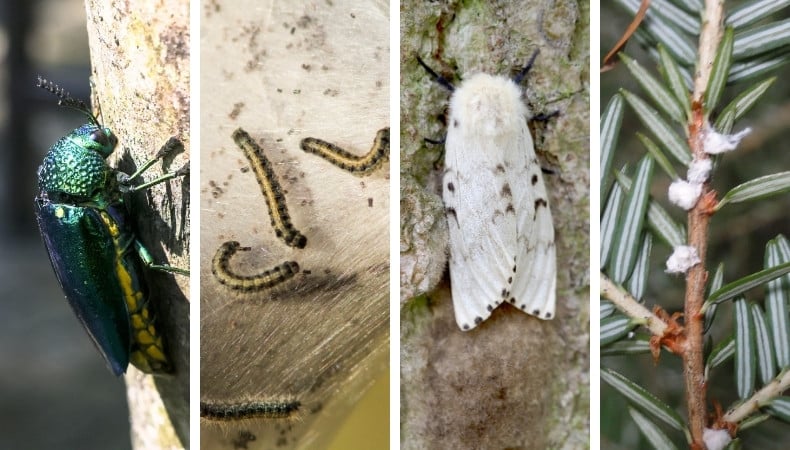
The four pests Vermont homeowners are most likely to encounter (left to right): emerald ash borer, forest tent caterpillar, spongy moth, and hemlock woolly adelgid.
What Tree Pests Are Most Concerning in Vermont?
A handful of pests regularly show up in Vermont yards, and a few of them can do serious damage if left alone. Emerald ash borer is the most urgent of the group, but homeowners should also know how to spot the others.
Emerald Ash Borer (EAB)
Emerald ash borer is an invasive beetle that kills ash trees. In Vermont, it was first detected in 2018. Now, it’s confirmed in 13 of the state’s 14 counties. In towns like Williston, South Burlington, and Essex—where ash has historically made up a large share of street and yard trees—this is the pest homeowners need to understand. Untreated, an infested ash tree can decline within three to five years.
Look for at least two of the following signs before deciding it’s EAB, since any one symptom on its own can have other causes:
- Woodpecker “Blonding”: Light-colored patches on the trunk where woodpeckers have flecked off outer bark to reach larvae underneath.
- D-Shaped Exit Holes: About 1/8 inch across and distinctly shaped like a capital D.
- Canopy Dieback: Thinning that starts at the top of the tree and progresses down.
- Epicormic Sprouting: Leafy shoots emerging directly from the trunk and lower limbs as a stress response.
- S-Shaped Galleries: Winding tunnels visible under loose bark if you can see underneath.
Forest Tent Caterpillar
A native defoliator that targets sugar maples during cyclical outbreaks that can last multiple years. Caterpillars appear in the spring and can strip leaves from entire trees in just weeks. A single defoliation weakens but rarely kills a healthy tree, but repeated years of defoliation can.
Spongy Moth (Formerly Gypsy Moth)
Another spring defoliator, but with a much broader appetite for hardwood—covering oaks, maples, birches, and more. Vermont saw around 43,000 acres defoliated by spongy moth during an outbreak in 2022. Keep an eye open for fuzzy tan egg masses on trunks in late winter and emerging caterpillars in May and June.
Hemlock Woolly Adelgid (HWA)
A serious pest for anyone with hemlock hedges or specimen trees. HWA looks like small white cotton balls on the undersides of needles and causes needle yellowing, branch dieback, and eventually tree death. It’s been spreading through Vermont, and a professional can confirm identification and treat infested trees.
What Tree Diseases Are Most Common in Vermont?
Diseases can be more difficult to spot than pests because the symptoms usually look like general stress. These are the diseases Vermont homeowners tend to encounter most often on shade trees, along with some insight for anyone with ornamental crabapples or fruit trees.
Beech Leaf Disease (BLD)
Vermont’s newest major forest disease, BLD, was initially confirmed in the state in 2023 and is now in six counties, including Chittenden County as of 2024. BLD is caused by an invasive nematode, and the telltale sign is dark striping or banding between the veins of beech leaves at budbreak. Right now, the priority is identification and monitoring—as there is no reliable homeowner treatment, and professional options are still experimental.
Cytospora Canker
Common on stressed spruce, especially the Colorado and Norway spruces typically planted as windbreaks and specimen trees. Sunken, discolored cankers form on branches, which then die back from the tip inward. Cytospora is usually a symptom of underlying stress like drought, poor siting, or soil compaction instead of a primary killer.
Apple Scab and Fire Blight
For homeowners with ornamental crabapples or fruit trees, apple scab shows up as olive-green to black spots on leaves and fruit. Fire blight causes branches to blacken and curl into the shape of a shepherd’s crook. Both are manageable with proper pruning practices and, in some instances, professional treatment.
Verticillium Wilt
A soil-borne fungus that affects maples and many other hardwoods. Symptoms typically look like drought stress: sudden branch flagging, wilting leaves, and discolored wood visible under the bark when a branch is cut. Generally, it’s misdiagnosed, but a Certified Arborist can confirm it. Management focuses on keeping the rest of the tree as healthy as possible.
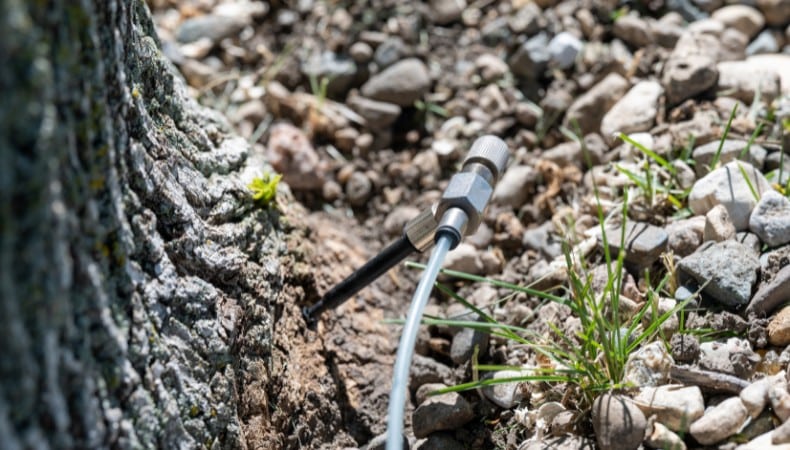
Trunk-injected insecticide delivers treatment directly into the tree’s vascular system—the standard method for protecting ash trees from emerald ash borer.
Should You Treat or Remove a Tree?
When a pest or disease shows up, the goal is to determine whether the tree is still a good candidate for treatment or if removal is the safer long-term option. That usually comes down to the severity of decline, the tree species, and where the tree is located on the property.
Treatment May Make Sense When:
- The canopy is still mostly healthy with limited dieback.
- The pest or disease has been caught early.
- The tree has strong structural integrity.
- The tree provides significant landscape, shade, or property value.
For example, ash trees with early-stage EAB can often be preserved with trunk injections every one to two years, while hemlocks affected by HWA may respond well before decline becomes severe.
Removal Is Usually the Better Option When:
- The tree has major canopy loss or extensive dieback.
- Structural decay or brittleness is present.
- The tree poses a risk to homes, driveways, power lines, or gathering areas.
- Decline has progressed beyond what treatment can realistically improve.
Dead ash trees, in particular, become brittle quickly and more dangerous—and expensive—to remove over time. The same can apply to heavily declined hemlocks or stressed spruces affected by Cytospora.
How Can You Keep Your Trees Healthy and Reduce Pest and Disease Risk?
Healthy trees resist pests and diseases much more effectively than stressed ones. Most of what goes wrong in a Vermont yard starts below—drought stress, compacted soil, improper mulch, or root damage from lawn equipment. The following are practices to keep in mind:
- Proper mulching is a good first step: two to four inches deep, kept pulled back off the trunk instead of piled into a volcano.
- Keep younger and recently planted trees regularly watered through summer droughts; established trees benefit from deep soakings during extended dry periods.
- Keep your mowers and string trimmers clear of trunks, since even small bark wounds create entry points for pests and diseases.
- Don’t prune ash trees between May and September, since fresh wounds during EAB flight season actively attract beetles.
- Schedule annual plant health care inspections with a Certified Arborist to catch problems while they’re still treatable.
Frequently Asked Questions About Tree Pests and Diseases in Vermont
How do I know if my ash tree has emerald ash borer?
Look for at least two of these signs: woodpecker “blonding” on the trunk, D-shaped exit holes about 1/8 inch across, thinning in the upper canopy, and leafy shoots emerging along the trunk. Any one sign by itself isn’t proof, but two or more together are heavy indicators of EAB.
Can an infested ash tree be saved?
Yes, if it’s caught early. Trunk-injected insecticide treatments can protect ash trees that aren’t yet heavily infested, repeated every one to two years for the tree’s life.
What does EAB treatment involve?
A Certified Arborist trunk-injects an insecticide during the growing season, usually late spring through mid-summer, when a tree is actively moving water and nutrients up from the roots. The treatment must be repeated every one to two years to remain effective.
Is beech leaf disease in Vermont?
Yes, BLD was first confirmed in Vermont in 2023 and has since spread to six counties, including Chittenden County in 2024. There’s no dependable homeowner treatment available right now, and identification and monitoring are of utmost importance for affected trees.
How do I tell if my tree is sick or just stressed?
Stress and disease tend to share early symptoms: wilting, thinning, and discolored leaves. The difference generally shows up in the pattern of stress affecting a tree evenly, while many diseases and pests cause uneven or localized symptoms.
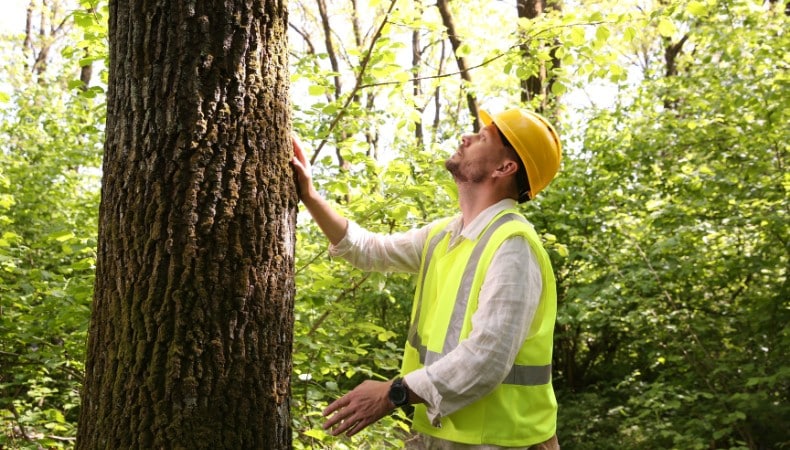
A certified arborist evaluates tree health on-site—the kind of professional assessment that determines whether a tree is a candidate for treatment or removal.
Protecting Great Trees Starts with an Inspection from Limbwalker Tree Service
Across Vermont, there’s a similar theme amongst tree pests and diseases. EAB is the most urgent one, BLD is the newest, and most other pest and disease problems come down to catching them before damage turns permanent. Great trees are not an accident, and spotting trouble early can be the difference between a treatment plan and a removal invoice.
If you have an ash tree in Williston, South Burlington, Essex, or anywhere in Chittenden County, schedule an inspection with a Certified Arborist from Limbwalker this spring, while the treatment window is still open. Call us today at 802-989-9343.
Vermont, Let’s Grow Great Trees Together
Whether you need pruning, planting, removal, pest and disease management, or help navigating a shoreline protection permit, we’re here and ready to bring our experience to your property.
Our Articles!
How to Identify Hazardous Trees in Vermont
Worried about a tree on your property? Learn the warning signs of hazardous trees in Vermont and when professional evaluation or removal may be needed.
Best Flowering Trees to Plant in the Champlain Valley
A helpful guide to discover the best flowering trees in Vermont, including the best species for the Champlain Valley, when to plant, and first-year care tips.
What Are the Best Fruit Trees for Vermont?
Planting fruit trees in Vermont can be incredibly rewarding, but only if you choose varieties that can withstand our unique weather patterns. With over 25 years of tree service experience in the Burlington area, our certified arborists have seen firsthand which fruit trees do well and which ones property owners have challenges with and…
